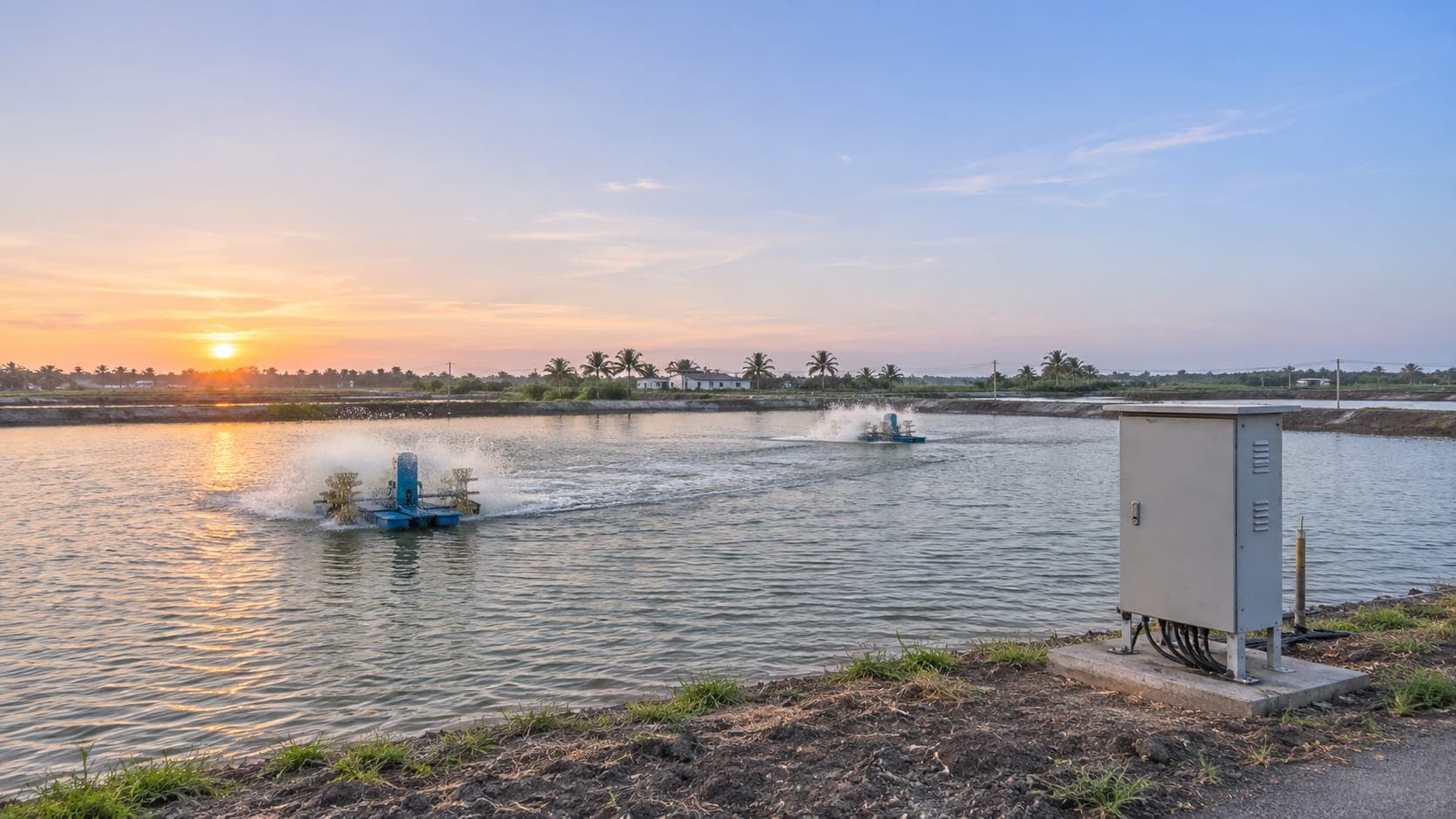
A coastal fish pond in southern Taiwan: paddlewheel aerators throwing up spray and a power panel at the pond edge
SOLUTIONS · FISH POND

How to Monitor Dissolved Oxygen in a Fish Pond: Automatic Aerators at Night and Power Logging

Fish ponds usually run short of oxygen at night, when no one is watching. Using three short clips from one night, this article shows how paddlewheel aerators, a dissolved oxygen sensor, a power meter and remote monitoring work together as one system: when oxygen drops, the aerators start on their own and you are notified at home.

Published
20:00 → 06:00

One night at the pond

All three clips are illustrative. They show how the system handles problems during the night. The night’s dissolved oxygen, water temperature and power readings are all kept in the built-in log and can be exported.

Oxygen below threshold: aerators start automatically

BEFORE

Someone has to take measurements at the pond in the dark, so the only option is to keep the aerators running all night.

AFTER

RIO detects that dissolved oxygen has fallen below the set threshold and switches on the contactors, so the aerators run and oxygen recovers. An email notification goes out at the same time.

Network outage: on-site control continues

BEFORE

Without a monitoring system, the only way to check oxygen and the aerators is to go out to the pond, even at night.

AFTER

The control logic runs on RIO and does not depend on the network, so the aerators keep running. Oxygen and power readings are still written to the CGate log and are sent once the network is back.

Aerator stops: instant alert

BEFORE

It is only discovered on the morning pond check, by which time oxygen has already fallen too low.

AFTER

CGate reads the Modbus power meter. When an aerator that should be running draws no current, an alert goes out immediately.

ARCHITECTURE

System architecture and devices

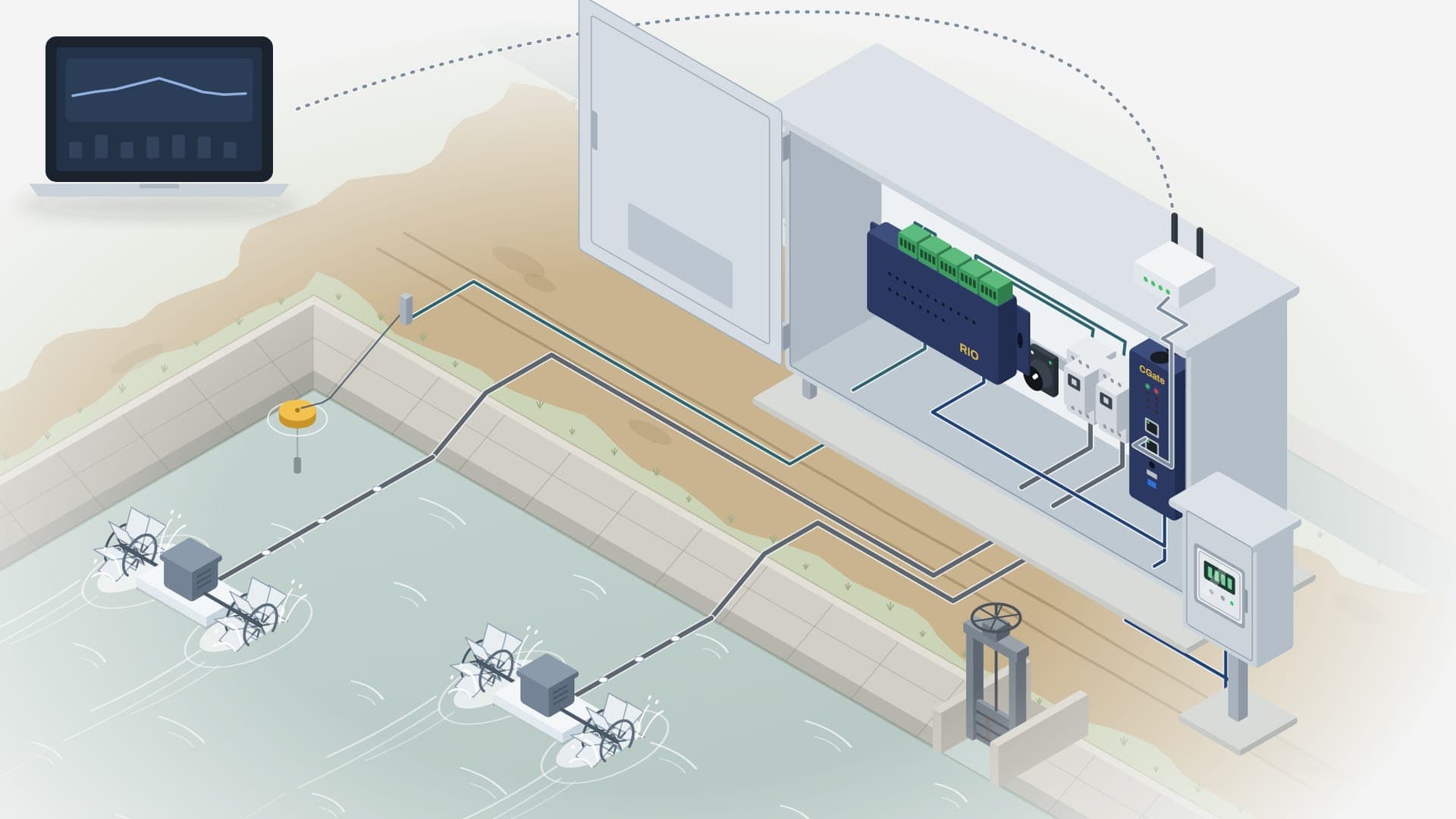
Behind that night is a single system: the dissolved oxygen sensor sends two 4~20mA signals (oxygen and water temperature) to RIO, which controls the aerators on site; the power meter connects to CGate for power logging; and CGate forwards data and alerts to a computer.

Fish pond dissolved oxygen monitoring architecture: the DO sensor and aerators in the pond; RIO, contactors and CGate in the power panel, with the meter box beside it; a router linking to a remote computer
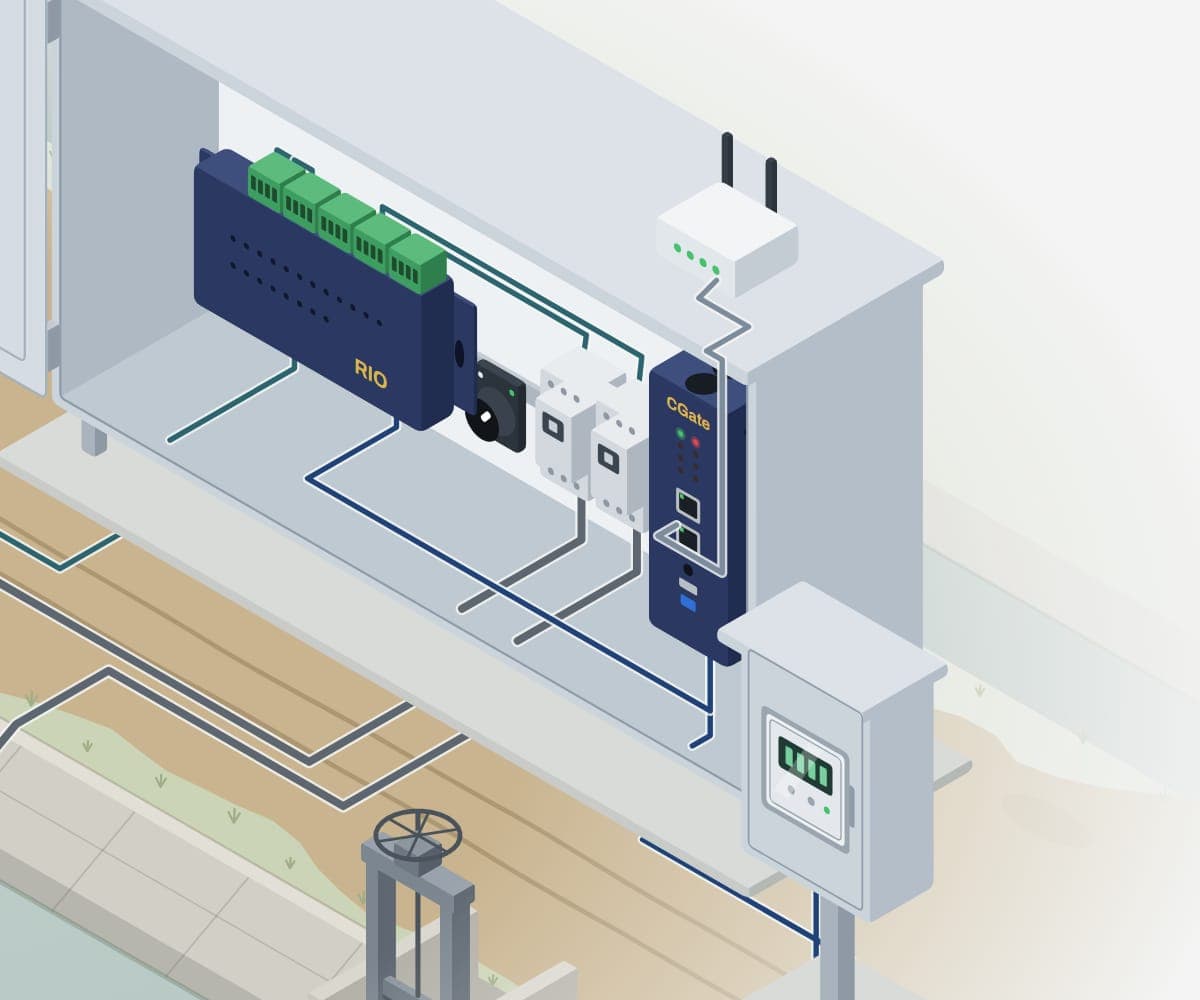
Close-up of the fish pond power panel: RIO, contactors, manual/auto selector, CGate and router, with the Modbus meter box on the right
Dissolved oxygen sensorTwo 4~20mA outputs (oxygen and water temperature), wired to RIO AI inputs
RIO Expandable I/O Module ControllerAI inputs read the DO sensor and a relay module drives the contactor coils; a built-in DDC program switches the aerators by the oxygen threshold on site
CGateReads the power meter, keeps a continuous log and sends email alerts; connects through a router or optional 4G
Modbus power meterMeasures aerator current and energy use; connected to CGate

RIO Expandable I/O Module Controller

AI inputs read the DO sensor and a relay module drives the contactor coils; a built-in DDC program switches the aerators by the oxygen threshold on site

Aerator power
4~20mA and relay signals
RS-485 (meter and RIO to CGate)
Network cable
Wireless link

CGate

GATEWAY
  • Connects directly to a Modbus power meter to log power use and operating status
  • Alerts when an aerator draws no current
  • Built-in, exportable log that keeps recording when offline
View CGate products

RIO

REMOTE I/O
  • AI: 4~20mA signal from the dissolved oxygen sensor
  • Relay module: drives the contactor coils
  • Built-in DDC program: starts the aerators when oxygen falls below the threshold
  • Runs on site and keeps controlling when the network is down
View RIO products

4G connectivity

OPTION
  • No wired network on site? Remote viewing and alerts go over cellular
  • Optional on CGate-05/06
FAQ

Questions before you start

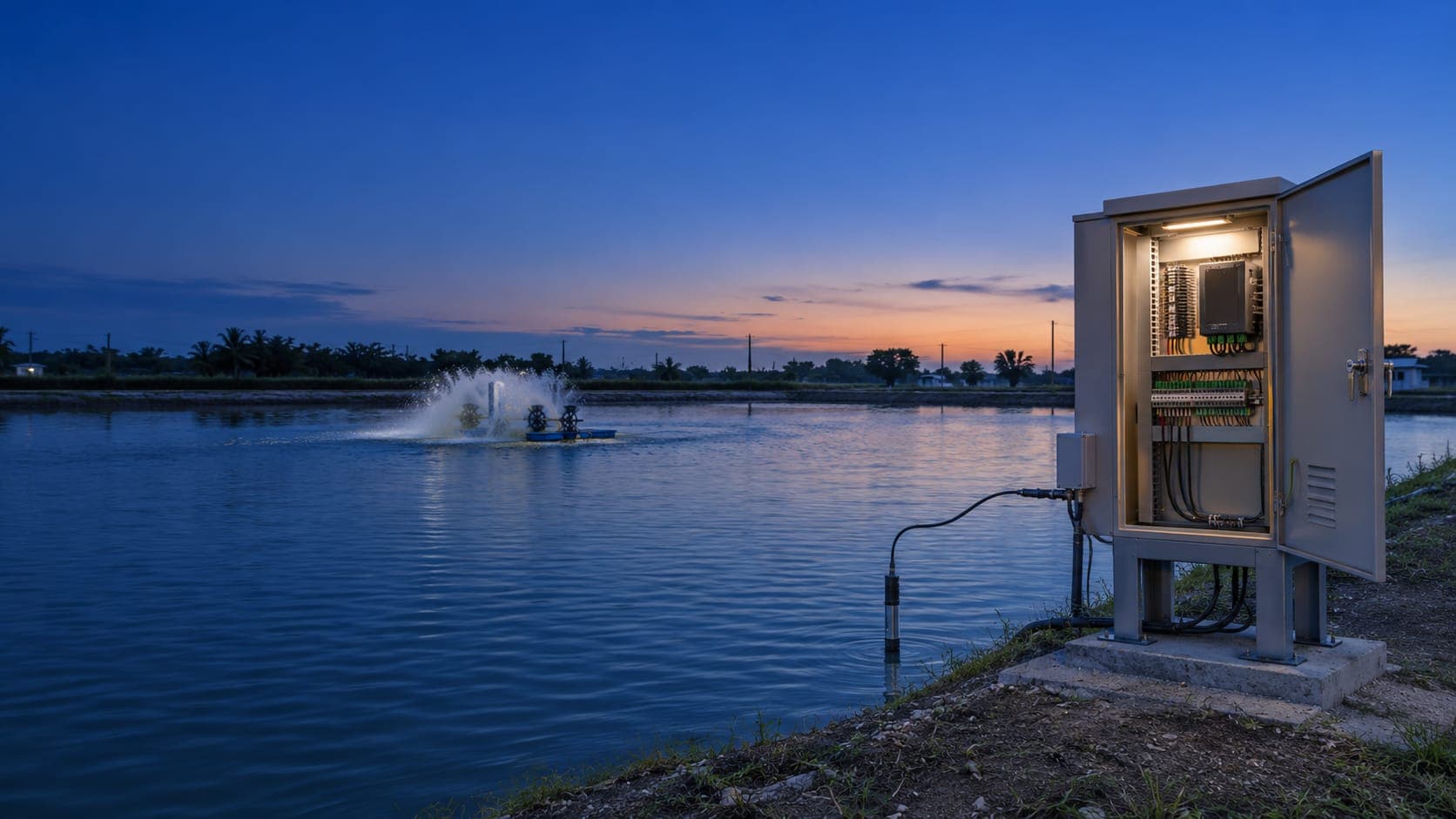
A fish pond at dusk: the control cabinet door half open with its light on, a dissolved-oxygen sensor cable running into the water, and an aerator splashing in the distance

What happens in a power outage?

The system needs power too, so during an outage a generator with an automatic transfer switch (ATS) has to supply it. Once power returns, RIO resumes control according to its settings.

What can it do during a cold snap?

It keeps logging water temperature and can send a low-temperature alert, giving you early notice. Cold-protection measures still need to be prepared in advance.

How is the dissolved oxygen sensor maintained?

The sensor needs regular cleaning and calibration, which the system cannot do for you. When a reading looks wrong, someone still has to check it.

Can the existing aerator switches still be used?

Yes. The power panel keeps its manual/auto selector switch, so manual operation works as before, even if the system has a problem.

Can a pond without internet use it?

Yes. On-site control does not need a network: RIO keeps switching the aerators by oxygen level and CGate keeps logging. For remote viewing and alerts, add the 4G option.

TAILORED TO YOUR SITE

Every pond is different

The number of aerators, voltage and phase, alarm conditions, notification methods (such as LINE) and control logic can all be tailored to your site. Tell us about your pond and power panel, and our sales team will help you plan the setup.

Contact us